
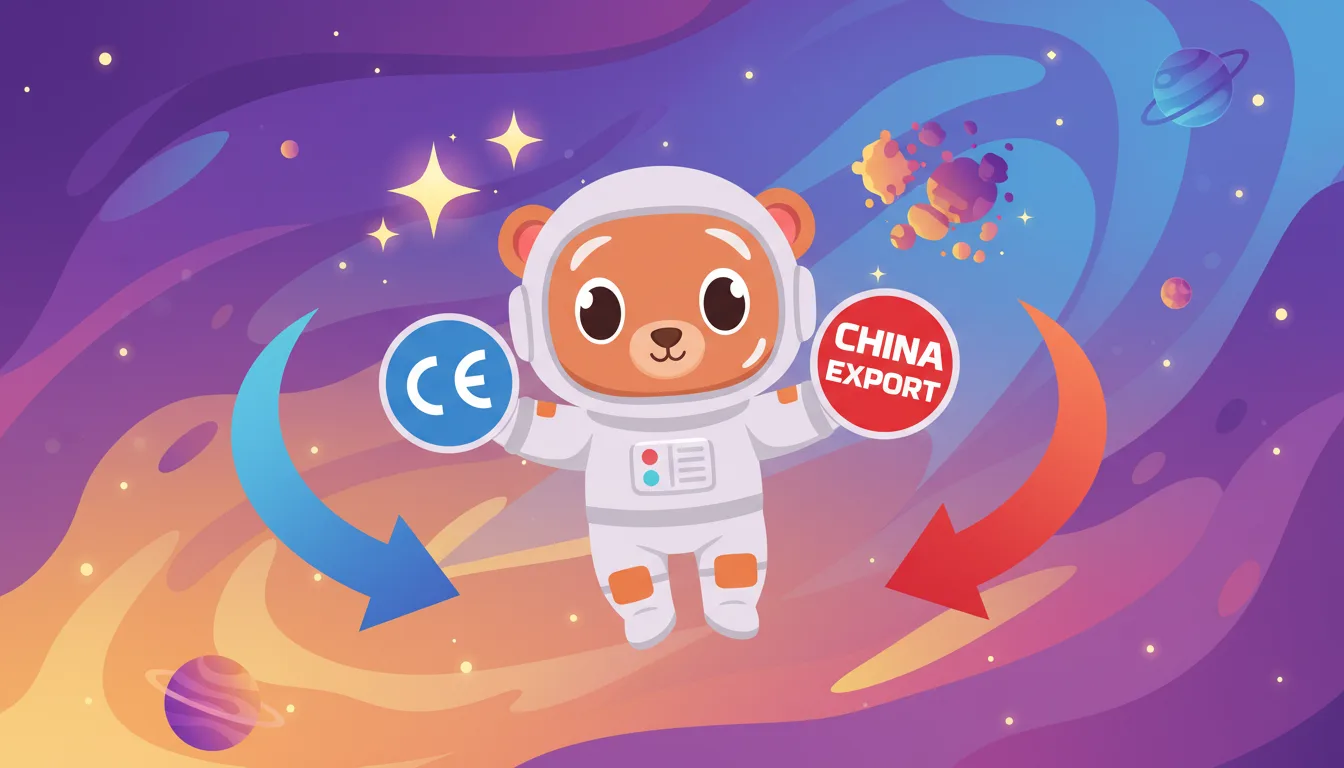
The difference between CE vs China Export is one of the most underestimated risks for online entrepreneurs importing products from China. Both labels use the letters "CE", but the meaning and legal implications are completely different. In this comprehensive guide, we'll explain exactly how to identify CE vs China Export, which EU directives apply, and how you as a bol.com seller can protect your business from fines, claims, and sales bans.
What's the difference between CE vs China Export?
The CE marking (Conformité Européenne) is a legally required certification that indicates a product complies with all relevant EU directives for health, safety, and environmental protection. The China Export label, on the other hand, is merely an indication of origin - it says nothing about the quality or safety of a product.
The problem is that both labels use the letters "CE" and look very similar visually. Many importers - even experienced entrepreneurs - fall into this trap and think their products are CE-certified when they only have a China Export label.
Visual identification: recognizing CE vs China Export
The visual difference between the two labels lies in the distance between the letters. On the official CE marking, the letters "C" and "E" are farther apart, with a specific minimum spacing. On the China Export label, the letters are closer together, with the middle line of the "E" touching the "C".
| Characteristic | CE marking (Europe) | China Export label |
|---|---|---|
| Meaning | Conformité Européenne - complies with EU standards | China Export - indication of origin |
| Letter spacing | Clear space between C and E | Letters almost touch each other |
| Legal status | Required for sale in the EER | No legal value in the EU |
| Quality guarantee | Yes - tested according to EU directives | No - no quality testing |
| Documentation | DoC, test reports, technical dossier | No documentation required |
| Notified Body | Sometimes required (depending on product category) | Not applicable |
| Minimum size | 5 mm height, fixed proportions | No specifications |
| Consequences of incorrect use | Fines up to €45,000, recall action | Misleading consumers |
EU directives per product category
Not all products fall under the same CE directives. The specific requirements depend on the type of product you import. Below is an overview of the most important categories for bol.com sellers:
Electronics and electrical appliances
Electrical products must comply with the Low Voltage Directive (2014/35/EU) and the EMC Directive (2014/30/EU). Think of chargers, kitchen appliances, lighting, and personal care appliances. This category often requires conformity tests at a recognized laboratory. Use the Product Database to see which competitors are active in this category.
Toys
The Toy Safety Directive (2009/48/EG) sets strict requirements for mechanical and physical properties, flammability, chemical composition, and electrical properties. For toys, a Notified Body is always involved in the assessment. This is one of the most heavily regulated categories.
Personal protective equipment (PPE)
Face masks, safety glasses, and work gloves fall under the PPE Regulation (EU 2016/425). Depending on the risk category (I, II, or III), different certification levels are required. Category III - protection against deadly risks - always requires a Notified Body.
Medical devices
The MDR regulation (EU 2017/745) has been in effect since May 2021 and sets very strict requirements for medical devices. Even simple products like band-aids or thermometers fall under this category. The certification costs are significantly higher than in other categories.
| Product category | EU directive | Notified Body required? | Average test costs | Lead time |
|---|---|---|---|---|
| Electronics | LVD + EMC | Mostly not | €800 - €3,000 | 4-8 weeks |
| Toys | 2009/48/EG | Yes | €1,500 - €5,000 | 6-12 weeks |
| PBM Cat. I | EU 2016/425 | No | €500 - €1,500 | 3-6 weeks |
| PBM Cat. II-III | EU 2016/425 | Yes | €2,000 - €8,000 | 8-16 weeks |
| Medical devices | MDR 2017/745 | Yes | €5,000 - €25,000 | 12-24 weeks |
| Machines | 2006/42/EG | Sometimes (Annex IV) | €1,000 - €4,000 | 6-10 weeks |
| Cosmetics | EC 1223/2009 | No (CPNP notification) | €1,000 - €3,500 | 4-8 weeks |
| Construction products | EU 305/2011 | Yes | €2,000 - €10,000 | 8-16 weeks |
The CE certification process in 6 steps
As an importer, you are legally responsible for the CE marking, regardless of what your Chinese supplier claims. Here's the full process:
Step 1: Determine which directives apply
Identify all EU directives that apply to your product. For example, an electric lamp may fall under the LVD, EMC, and RoHS directives. Use the EU product database NANDO to find recognized Notified Bodies.
Step 2: Compile a technical file
The technical file contains product descriptions, design drawings, risk analyses, test results, and the user manual. You must keep this file for at least 10 years after the product is placed on the market.
Step 3: Conduct conformity tests
Send product samples to a recognized European test laboratory. Do not accept Chinese test results unless the lab is officially recognized as a Notified Body. Include the test costs in your product calculation using the Profit Calculator.
Step 4: Draw up the Declaration of Conformity (DoC)
The DoC is a legally binding document in which you, as the importer, declare that the product complies with all relevant EU directives. This document must include the product name, the applied standards, your company details, and a signature.
Step 5: Affix the CE marking
The CE marking must be affixed to the product or packaging in a visible, legible, and indelible manner. The minimum height is 5 mm, and the proportions must match the official CE logo.
Step 6: Keep documentation and monitor
Keep all documentation (technical file, DoC, test reports) for at least 10 years. Also, monitor changes in EU directives that may impact your existing certification. Keep track of your product portfolio via the Sales Dashboard.
5 common mistakes with CE vs China Export
Based on the experiences of bol.com sellers, these are the most common mistakes when dealing with CE vs China Export labels:
1. Blindly trusting supplier certificates
Many Chinese suppliers claim that their products are "CE certified" and provide certificates. Unfortunately, these documents are often forged, expired, or issued by non-recognized authorities. Check each certificate via the NANDO database of the European Commission.
2. Mistaking the China Export label for the CE marking
The visual similarity between the two labels is the core of the problem. Always measure the distance between the letters and compare it with the official CE specifications. If in doubt, have the product retested.
3. Not applying all relevant directives
A product can fall under multiple EU directives. For example, electric children's toys must comply with both the Toy Directive and the LVD and EMC. Missing one directive makes the entire CE marking invalid.
4. Not keeping a technical file
The NVWA can ask for access to your technical file at any time. Without a complete file, you risk immediate removal of your products from sale and hefty fines.
5. Not updating certification after product changes
Every significant change to a product - different material, different component, different supplier - may require a new conformity assessment. Keep track of product variants with the Product Tracker.
NVWA inspection: what you need to know
The Dutch Food and Consumer Product Safety Authority (NVWA) monitors the safety of non-food consumer products. They conduct random inspections, also at online marketplaces like bol.com.
What does the NVWA check?
During an inspection, the NVWA asks for: the technical file, the Declaration of Conformity, test reports from recognized labs, the correct application of the CE marking on the product, and the Dutch or English user manual.
Possible sanctions
The sanctions vary from a warning for minor defects to fines of €450 to €45,000 per violation. In case of serious risks, the NVWA may demand a sales ban, recall, or even destruction of the stock. Calculate the financial impact in advance with the Winstcalculator.
Practical checklist for safe importing
Use this checklist with every new import from China to check if your CE vs China Export situation is in order:
| Step | Action | Check |
|---|---|---|
| 1 | Visual inspection of CE label | Are the letters C and E at the correct distance? At least 5 mm high? |
| 2 | Validate certificate | Is the issuing lab in the NANDO database? |
| 3 | Check directives | Have all relevant EU directives been identified? |
| 4 | Technical file | Is it complete with test reports, DoC, and risk analysis? |
| 5 | Product labeling | CE marking, importer information, user manual in Dutch? |
| 6 | Document storage | Is everything stored digitally for at least 10 years? |
| 7 | Margin calculation | Have test costs been included in the selling price? |
| 8 | Supplier verification | Have independent product samples been tested? |
Frequently asked questions about CE vs China Export
How do I check if my product is really CE certified?
Check the distance between the letters C and E (they must be clearly separated), verify the certificate in the NANDO database, and request the technical file from your supplier. If in doubt, have an independent European lab test the product.
What if my supplier says the product has CE certification?
Don't blindly trust suppliers' claims. Ask for the technical file, the Declaration of Conformity, and the test reports. Check if the mentioned Notified Body actually exists via the NANDO database. As an importer, you are always ultimately responsible.
Can I sell a product without a CE marking on bol.com?
No, products that fall under CE-compliant categories cannot be sold in the EU without a valid CE marking. Bol.com can suspend your account and the NVWA can impose fines. Check in advance which products are CE-compliant using the Product Database.
How much does it cost to obtain a CE marking?
The costs vary greatly per product category: from €500 for simple products to €25,000+ for medical devices. Additionally, consider costs for documentation, translation, and potential product adjustments. Plan this budget into your product calculation via the Winstcalculator.
Does CE vs China Export also apply to products from Alibaba?
Yes, especially with Alibaba suppliers, there's a high risk of China Export labels. Many Alibaba sellers present the China Export label as a CE marking. Always order a sample first and have it independently tested before placing a large order. Analyze your product market with the Product Tracker before you invest.
Start your 30-day free trial with Boloo
Use Boloo's tools to sell smarter on bol.com. Try it free for 30 days.
Try Boloo free for 30 days