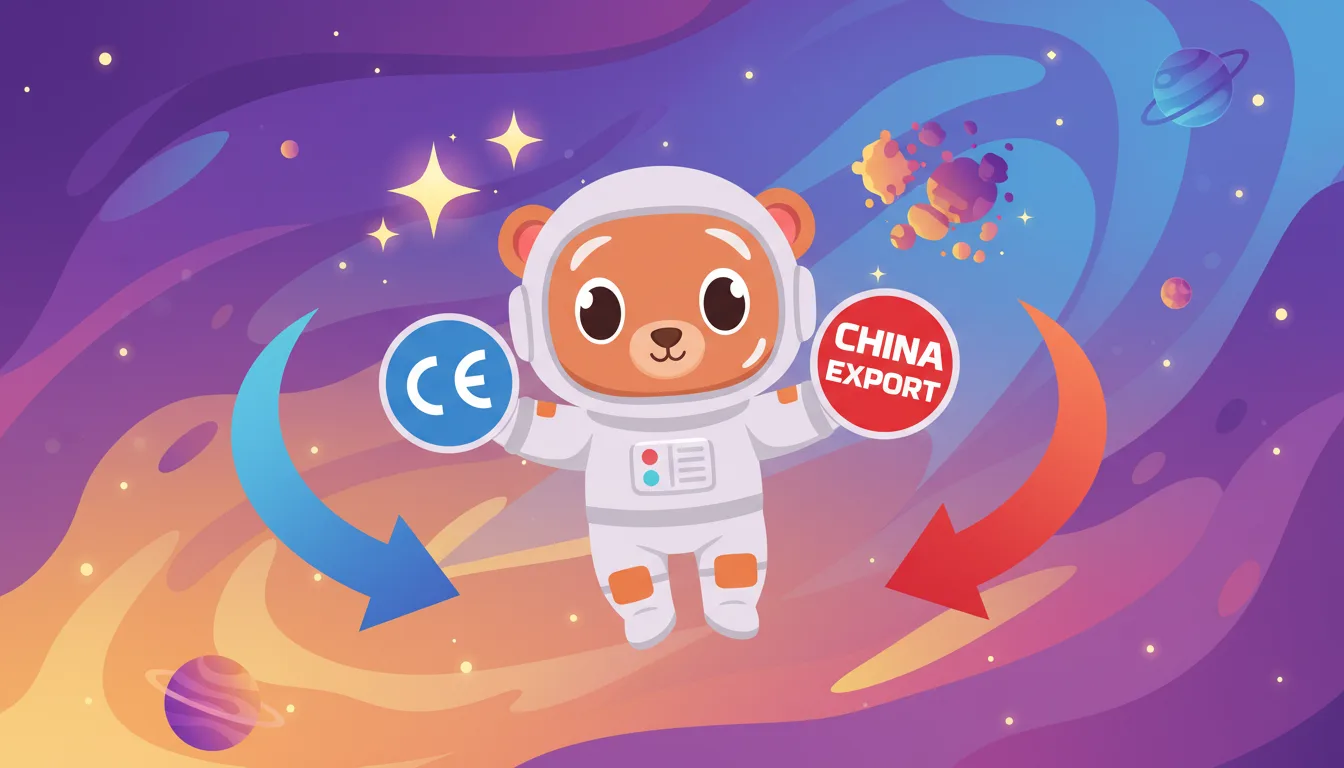

If you import products from China to sell on platforms like bol.com, understanding the CE logo China is an absolute must. The difference between the official CE marking and the so-called China Export label can mean the difference between a successful business and serious legal issues. In this comprehensive article, we'll explain everything about the CE logo, the Chinese variant, how to recognize them, and what you as an entrepreneur need to do to stay compliant.
What is the CE logo and why is it important for products from China?
CE stands for Conformité Européenne, which literally means 'European conformity'. It's a mandatory marking for a wide range of products sold on the European market. When a product carries the CE logo, the manufacturer or importer indicates that the product complies with all applicable EU directives and regulations regarding safety, health, and the environment.
The CE marking is not a certification awarded by an independent institution - it's a self-declaration by the manufacturer or importer. This means that as an importer of products from China, you bear full responsibility for affixing the CE marking. You must be able to demonstrate that the product meets all relevant requirements, including technical documentation, test results, and a Declaration of Conformity.
The CE logo from China: China Export vs European CE marking
One of the most common pitfalls for importers is confusing the European CE marking with the CE logo China, also known as the China Export label. Although both labels contain the letters 'C' and 'E', they have fundamentally different meanings. The China Export label simply indicates that a product was produced in China - it says nothing about quality, safety, or compliance with European regulations.
The problem is that some Chinese manufacturers intentionally or unintentionally use the China Export label in a way that resembles the European CE marking. This can mislead importers, especially if they're not aware of what to look for.
Visual differences between CE marking and China Export
The main visual difference lies in the distance between the letters. The official European CE marking has a clear space between the 'C' and the 'E'. The China Export label has the letters closer together, almost overlapping. Additionally, the official CE marking has specific proportions defined in EU legislation:
| Characteristic | CE marking (EU) | China Export label |
|---|---|---|
| Meaning | Conformité Européenne - complies with EU directives | China Export - produced in China |
| Letter spacing | Clear space between C and E | Letters are close together / overlapping |
| Minimum height | 5 mm (legally defined) | No defined dimensions |
| Proportions | Standardized grid (EU regulation 765/2008) | No standardized design |
| Legal status | Legally required for certain product groups | No legal basis in the EU |
| Declaration of Conformity | Required - DoC must be available | Not applicable |
| Test report | Required by a notified body (depending on the directive) | Not required |
| Liability | Importer is responsible | No legal protection |
Which products require a CE marking?
Not all products you import from China require a CE marking. The obligation applies to product categories that fall under specific EU directives. Below, you'll find the most important categories relevant to online sellers:
Product categories with CE marking requirement
| Product category | Applicable EU directive | Examples |
|---|---|---|
| Toys | Directive 2009/48/EG (Toy Safety) | Puzzles, stuffed animals, board games, building sets |
| Electronics | LVD 2014/35/EU + EMC 2014/30/EU | Chargers, lighting, kitchen appliances |
| Personal protective equipment | Regulation (EU) 2016/425 | Helmets, safety shoes, hearing protection |
| Medical devices | MDR (EU) 2017/745 | Blood pressure monitors, thermometers, bandages |
| Machines | Directive 2006/42/EG | Tools, small machines, industrial equipment |
| Construction products | Regulation (EU) 305/2011 | Fasteners, insulation materials |
| Radio equipment | RED 2014/53/EU | Bluetooth speakers, wireless headphones, wifi devices |
Products like clothing, non-electric furniture, and pure decorative items are generally not subject to CE marking requirements. Always check with the European Commission to see if your specific product falls under a directive.
Step-by-step: Applying for a CE marking for Chinese products
As an importer, you are responsible for the CE marking - not the Chinese manufacturer. Below, we explain the entire process:
1. Identify the applicable directives
Determine which EU directives your product falls under. A product can fall under multiple directives - for example, electronic toys fall under both the Toy Directive and the EMC and LVD directives. Use the Boloo Product Tracker to analyze similar products on bol.com and see which certifications they mention.
2. Determine the conformity assessment procedure
Depending on the directive and the product's risk level, you may be able to assess conformity yourself (internal production control) or need to involve a notified body. For toys and certain electronics, an external assessment is almost always required.
3. Have the product tested
Send product samples to an accredited testing laboratory. In the Netherlands, well-known institutions like SGS, TÜV, and Bureau Veritas are active. Testing costs vary:
- Simple products (e.g., textiles, accessories): €200 – €800
- Electronics (EMC + LVD): €1,000 – €5,000
- Toys (full EN 71 suite): €1,500 – €4,000
- Complex equipment (machines, medical): €3,000 – €15,000+
4. Compile the technical documentation
You must create a technical file that must be available for at least 10 years. This includes product specifications, test reports, risk analyses, user instructions, and the declaration of conformity.
5. Draw up the declaration of conformity (DoC)
The Declaration of Conformity is an official document in which you, as the importer, declare that the product complies with all applicable directives. You must be able to present this document to market surveillance authorities, such as the NVWA or the Inspectie Leefomgeving en Transport, upon request.
6. Affix the CE marking
Only after completing all steps can you apply the CE marking to the product, packaging, or instructions. Ensure the marking meets the official dimensions (at least 5 mm high) and proportions.
Common mistakes when importing CE logos from China
Many starting importers make the same mistakes. Here are the most common pitfalls to avoid:
- Trusting manufacturer certificates: Chinese suppliers often provide CE certificates, but these are not always valid or reliable. Always have independent testing done in an EU-accredited lab.
- Not recognizing the China Export label: Always visually check if the marking on your product matches the official EU CE marking. Pay attention to letter spacing.
- Lacking a Declaration of Conformity: Without a DoC, you cannot sell the product, even if it has been tested.
- Applying the wrong directive: A product can fall under multiple directives. If you miss one, you are not compliant.
- Not keeping technical documentation: Market surveillance authorities can request documentation up to 10 years after sale.
Legal consequences of an incorrect CE logo
Selling products with a counterfeit or incorrectly applied CE logo can have serious consequences. In the Netherlands, the NVWA (Netherlands Food and Consumer Product Safety Authority) monitors consumer products. If you violate the rules, you may face:
- Fines of up to €900,000 per violation (for companies)
- Product recalls - you must recall all sold products at your own expense
- Sales ban on the platform (bol.com, Amazon, etc.)
- Criminal prosecution in case of serious safety incidents
- Reputation damage due to negative publicity and customer reviews
The risks are significant. It's better to invest in a correct CE procedure beforehand than to pay for the consequences later. With tools like the Boloo Product Tracker, you can research which products are already successfully on the market and what certifications are common in your product category.
Tips for safely importing CE products from China
Work with reliable suppliers
Use platforms like Alibaba to find suppliers, but always check their certifications. Ask for existing test reports, visit the factory if possible, and always order samples before placing a large order. Also, read our guide on finding suppliers for bol.com.
Hire a purchasing agent
An experienced purchasing agent in China can help you with quality controls, factory inspections, and verifying certifications. This is especially valuable if you import large quantities or work with private label products.
Use pre-shipment inspections
Have an independent inspection done before the goods are shipped. Companies like SGS and Bureau Veritas offer these services in China. During the inspection, it's also checked if the CE marking is correctly applied.
Comply with the Product Safety Regulation
As of December 2024, the new EU General Product Safety Regulation (GPSR) applies. This regulation sets stricter requirements for online marketplaces and importers. Make sure you are aware of the latest changes and adjust your processes accordingly.
Frequently asked questions about the CE logo from China
Is the China Export label illegal?
The China Export label itself is not illegal, but it must not be used to mislead consumers or authorities by giving the impression that it's a European CE marking. If a product requires a CE marking but only carries a China Export label, it cannot be sold in the EU.
Can I apply the CE marking myself?
Yes, but only if you've completed the full conformity assessment process. You need to have test results from an accredited laboratory, a technical file, and a valid declaration of conformity. Incorrectly applying the CE marking is punishable.
What if my supplier offers a CE certificate?
Be cautious. Many so-called CE certificates from Chinese suppliers are not valid in the EU. Check if the certificate was issued by a recognized Notified Body registered in the EU's NANDO database. If in doubt, have the product retested by a European lab.
How do I recognize a fake CE certificate?
Watch out for the following signs: the certificate doesn't mention a specific EU directive, the test laboratory is not listed in the NANDO database, the test results are vague or incomplete, or the certificate was issued by the manufacturer itself instead of an independent body.
Does the CE requirement also apply to dropshipping?
Yes. If you sell products that are shipped directly from China to customers in the EU, you're responsible for CE compliance as the seller. When dropshipping via bol.com, this is a particular point of attention, since you don't physically inspect the products yourself.
Start free with Boloo
Use Boloo's tools to sell smarter on bol.com. Try it for free.
Try Boloo for free