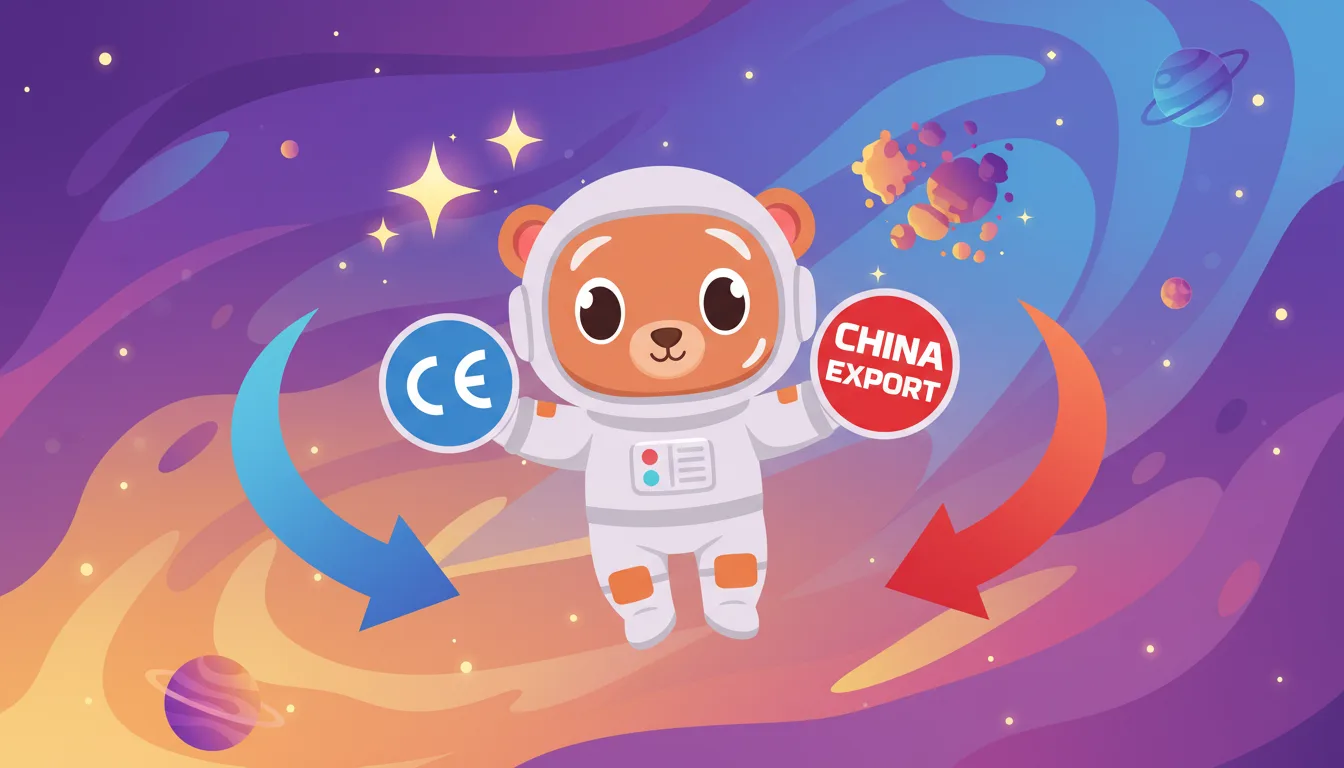

The difference between CE and China Export is one of the most underestimated pitfalls for online entrepreneurs importing products from Asia. At first glance, both logos look identical, but the legal and commercial consequences of confusion are enormous. In this article, we'll explain all aspects: from visual recognition and legal requirements to practical steps for compliance and common mistakes you'll want to avoid.
What is CE marking? The difference between CE and China Export starts here
CE stands for Conformité Européenne, or European Conformity. It's a mandatory marking for products sold within the European Economic Area (EEA) and falling under certain EU directives. The CE marking indicates that a product meets the applicable European standards for health, safety, and environmental protection.
Important: CE marking is not a quality mark in the classical sense. It's a mandatory declaration by the manufacturer or importer that the product complies with all applicable EU directives. The responsibility for the accuracy of this lies with the person who brings the product to the European market - and that's you as the importer. With a product tracker, you can explore the market and see which product categories require CE marking.
What is the China Export label?
The China Export label (sometimes abbreviated as "CE" but with a different spacing) is a marking used by Chinese manufacturers that simply indicates a product was produced in China. It has no relation to European law and regulation and provides no guarantee of quality, safety, or conformity. The China Export logo is not officially recognized by any international or European body.
The great confusion arises because the China Export label looks very similar to the European CE marking. Many Chinese suppliers - including those on platforms like Alibaba - place the China Export logo on products, which wrongly reassures inexperienced importers.
Visual and legal differences: CE marking vs China Export
The difference between CE and China Export is visually subtle but legally crucial. The following table provides a complete overview of all relevant differences:
| Feature | CE marking (European) | China Export label |
|---|---|---|
| Full name | Conformité Européenne | China Export |
| Letter spacing | Letters C and E are farther apart | Letters C and E are almost touching |
| Legal status | Mandatory for certain product groups in the EU/EEA | No legal recognition in the EU |
| Meaning | Product complies with EU directives for safety, health, and environment | Product is manufactured in China |
| Conformity assessment | Requires technical dossier, test reports, and EU conformity declaration | No assessment required |
| Supervisory authority | NVWA, customs, market surveillance per EU member state | No supervision |
| Liability | Importer is legally liable for correct CE marking | No liability attached to label |
| Fine amount for misuse | Up to €900,000 or criminal prosecution | N/A |
Which products require CE marking?
Not all products you import require CE marking. The obligation only applies to product categories that fall under specific EU directives. Below are the main categories for bol.com sellers:
| Product Category | Applicable EU Directive | Examples |
|---|---|---|
| Toys | Toy Safety Directive 2009/48/EG | Dolls, puzzles, building sets, board games |
| Electronics & Electricity | LVD 2014/35/EU, EMC 2014/30/EU | Chargers, lamps, kitchen appliances |
| Personal Protective Equipment | PPE Regulation (EU) 2016/425 | Safety glasses, helmets, gloves |
| Medical Devices | MDR (EU) 2017/745 | Blood pressure meters, thermometers |
| Machines & Tools | Machinery Directive 2006/42/EG | Drilling machines, compressors |
| Construction Products | Construction Products Regulation (EU) 305/2011 | Adhesives, insulation materials, fasteners |
| Radio Equipment | RED 2014/53/EU | Bluetooth speakers, wifi devices, drones |
Use the product database to research which product categories on bol.com are most profitable - and then check if CE marking is required before choosing a supplier.
Products without CE Requirement
Categories like clothing, furniture (without electrical components), books, cosmetics (own regulations), and food products are not subject to the CE directive but often have their own laws and regulations. Always check before importing.
Importer Obligations: Your Responsibility
If you import products from China and sell them on bol.com, you are legally the importer. This means you are responsible for the product's conformity - not your Chinese supplier. EU legislation imposes the following obligations:
- Conformity Assessment: Ensure the product is tested according to applicable EU standards. For some products, testing by a Notified Body is required.
- Technical File: Compile a technical file with test reports, product specifications, risk analysis, and user manuals.
- EU Declaration of Conformity (DoC): Sign a Declaration of Conformity stating that the product complies with all applicable directives.
- CE Marking: Affix the correct CE marking to the product, packaging, or documentation - at least 5 mm high.
- Traceability: Include your company name and address on the product or packaging.
- Retention Obligation: Keep the technical file for at least 10 years after the product is placed on the market.
With Boloo's automatic invoicing, you keep your administration in order - a requirement for the retention obligation of conformity documents.
Consequences of Incorrect CE Marking
The consequences of selling products with a false or missing CE mark are severe:
- Administrative: The NVWA or customs can seize products, demand a recall, or impose a fine of up to €900,000.
- Criminal: In case of repeated offenses or intentional fraudulent behavior, criminal prosecution may follow with possible imprisonment.
- Civil: If a product causes damage, you as the importer are liable for all damage to persons or property.
- Platform Sanctions: Bol.com can suspend or permanently block your account if you sell products without a valid CE marking.
- Reputation Damage: Negative reviews and media attention can permanently damage your brand.
6 Steps to Ensure CE Compliance
Follow these steps to ensure your products are correctly CE-marked:
Step 1: Identify applicable directives
Determine which EU directive(s) your product falls under. Use the EU database for harmonized standards or consult a compliance specialist.
Step 2: Conduct a risk analysis
Analyze all possible risks of the product for users, pets, and the environment. This is a mandatory part of the technical file.
Step 3: Have the product tested
Send samples to an accredited test laboratory in the EU (e.g., TÜV, SGS, or Bureau Veritas). For certain products, a Notified Body is required.
Step 4: Compile the technical file
Bundle all documentation: test reports, product specifications, risk analysis, production information, and user manuals in all relevant languages.
Step 5: Sign the declaration of conformity
Draw up the EU declaration of conformity and sign it. This document must be available upon request from the authorities.
Step 6: Affix the CE marking correctly
Place the CE marking on the product (or packaging if the product is too small). Pay attention to the correct proportions: the letters must be at least 5 mm high with the correct spacing.
7 common mistakes in CE marking and China imports
These are the most common mistakes importers make - and how you can avoid them:
- Relying on the supplier's "CE certificate": Chinese suppliers often claim their products are CE-certified. Always verify this with independent test reports.
- Confusing China Export with CE marking: Check the spacing of the logo. If in doubt: have it tested independently.
- Not creating a technical file: Many importers forget this. Without a technical file, you are not compliant by definition.
- Accepting test reports from the supplier: Suppliers' reports are often outdated, for a different model, or simply forged. Have it tested by an EU-accredited lab yourself.
- Forgetting to add traceability: Your company name and address must be on the product or packaging.
- Not re-testing product changes: If the supplier modifies the product (different material, different dimensions), you must go through the compliance process again.
- Focusing only on the CE logo: The CE marking is the final step in a process. Without test reports and a technical file, the logo is meaningless.
Use the keyword explorer to analyze which product niches are popular on bol.com - and then research the CE requirements before you place an order with your supplier.
Suppliers on Alibaba and CE claims: what to look out for?
Many suppliers on Alibaba, 1688, and Made-in-China claim their products have a "CE certificate". In practice, this often means:
- A self-created document without independent verification
- A China Export label presented as "CE"
- A test report for a different product model or an outdated version
- A report from a non-accredited laboratory
Always ask for the full test report from a recognized lab, the EU declaration of conformity, and the technical file. If the supplier cannot provide these, you must initiate and pay for the compliance process yourself. Expect costs of €500 to €5,000 per product, depending on the product category and the complexity of the tests.
CE marking and selling on bol.com
Bol.com is getting stricter about product safety. In collaboration with the NVWA, regular checks are carried out. If you sell products in a CE-required category without a valid marking, you risk:
- Removal of your product offer
- Suspension of your sales account
- Liability for consumer complaints
With the Sales Dashboard, you keep an eye on your sales and return percentages. A sudden increase in returns may indicate product safety problems that you need to investigate immediately.
Frequently asked questions about the difference between CE and China Export
What is the visual difference between CE and China Export?
The genuine CE marking (Conformité Européenne) has the letters C and E farther apart - you can place an imaginary letter in between. The China Export label has the letters almost touching. The proportions of the letters are also different: the CE marking follows a fixed geometric design.
Is the China Export label illegal?
The China Export label itself is not illegal. However, it becomes problematic when it is used to mislead consumers or authorities by presenting it as the European CE marking. In that case, it is a matter of product fraud and trademark infringement.
Can I apply the CE marking to my products myself?
Yes, as an importer, you are responsible for applying the CE marking - but only after the complete conformity process has been completed. This includes testing, technical dossier, and declaration of conformity. So, it's not just "applying a sticker" but the result of a thorough process.
How much does it cost to obtain the CE marking?
The costs vary greatly per product category. For simple consumer products (toys, simple electronics), you can expect to pay between €500 and €2,000. For complex products (medical devices, machines), this can range from €5,000 to €25,000 or more, including Notified Body costs.
What do I do if my supplier claims to have a CE certificate?
Ask for the full test report from an accredited EU laboratory, the EU declaration of conformity, and the technical dossier. Check if the report relates to exactly the same product model you want to import. If in doubt: have the product tested independently in Europe. The costs of this are outweighed by the risks of non-compliance.
Start your 30-day free trial with Boloo
Use Boloo's tools to sell smarter on bol.com. Try it free for 30 days.
Try Boloo free for 30 days