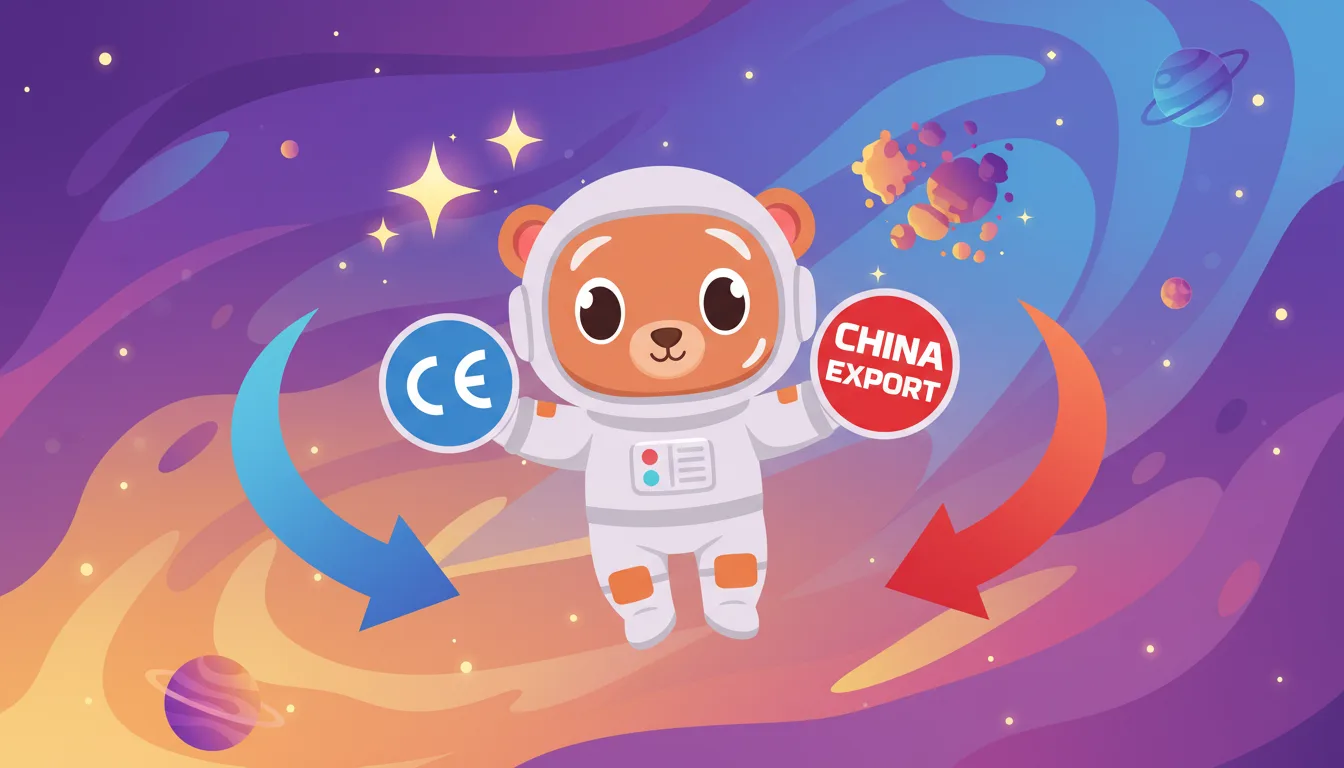

If you import products from China to sell on bol.com or other European marketplaces, the CE marking China is one of the most important topics you need to understand. The difference between a genuine CE marking and the misleading China Export label can mean the difference between a successful import business and thousands of euros in fines. In this comprehensive guide, we'll explain everything you need to know about CE certification when importing from China — from the legal basis to the practical steps you need to take.
What is CE marking and why is it mandatory?
CE stands for Conformité Européenne, which means 'European conformity'. The CE marking is a legally required indication for many product categories sold in the European Economic Area (EEA). It indicates that a product complies with all applicable EU directives regarding health, safety, and environmental protection.
The CE marking is not a quality mark in the classical sense, but a legal declaration by the manufacturer or importer that the product complies with European harmonization legislation. As an importer, you are legally responsible for the conformity of your products in the EU — regardless of what your Chinese supplier claims.
Which product categories require CE marking?
Not all products require a CE marking, but many popular import categories do. Below, you'll find an overview of the main EU directives and the products that fall under them:
| EU directive | Product categories | Examples | Risk classification |
|---|---|---|---|
| Toy Directive (2009/48/EG) | Toys for children under 14 years | Plush toys, puzzles, building sets | High |
| Low Voltage Directive (2014/35/EU) | Electrical appliances 50-1000V AC | Chargers, lamps, kitchen machines | Medium-High |
| EMC Directive (2014/30/EU) | Electromagnetic equipment | Bluetooth speakers, LED strips | Medium |
| Machinery Directive (2006/42/EG) | Machines and tools | Drill machines, cutting machines | High |
| Personal Protective Equipment Regulation (EU 2016/425) | Personal protective equipment | Safety glasses, gloves | High |
| Radio Equipment Directive (2014/53/EU) | Radio equipment | Wi-Fi routers, drones, walkie-talkies | Medium-High |
| RoHS Directive (2011/65/EU) | Electronics (hazardous substances) | All electronic products | Medium |
| REACH Regulation (EC 1907/2006) | Chemical substances in products | Cosmetics, textiles, plastics | Medium-High |
If you sell products via Boloo on bol.com, it's essential to check beforehand which directives apply to your product category. With the Boloo Product Database, you can see which product categories are popular and what certification requirements they have.
China Export vs genuine CE marking: the crucial difference
One of the biggest pitfalls when it comes to CE marking China is the so-called China Export label. This label looks very similar to the genuine CE marking but has a completely different meaning. The China Export label simply indicates that a product was produced in China for export — it says nothing about conformity with European standards.
Recognizing visual differences
The difference between the genuine CE marking and the China Export label lies in the distance between the letters:
| Feature | Real CE marking | China Export label |
|---|---|---|
| Meaning | Conformité Européenne | China Export (no official status) |
| Letter spacing | Space between C and E (E fits in the opening of C) | Letters C and E almost touch |
| Legal status | Mandatory by law for many products in the EU/EEA | No legal recognition in the EU |
| Declaration of Conformity | Requires technical file + DoC | No documentation required |
| Supervisory authority | NVWA, customs, market surveillance | Not recognized by any authority |
| Liability | Manufacturer/importer is legally liable | No legal basis |
A handy check is the coin test: download the official CE logo from the European Commission's website and place it next to the marking on your product. With the real marking, the letter E fits exactly in the opening of the C. With the China Export label, the letters overlap. Also, read our in-depth article on the difference between CE and China Export.
The CE certification process step by step
As an importer, you are legally responsible for the CE compliance of your products. Here is the complete process you need to follow:
Step 1: Determine which directives apply
Identify all EU directives that apply to your product. For example, an electronic toy may fall under the Toy Directive, the EMC Directive, and the Low Voltage Directive. Use the EU product database or consult a CE consultant to be sure.
Step 2: Check the harmonized standards
Each EU directive refers to harmonized standards (EN standards) that specify the technical requirements. Download the relevant standards from the European standardization institute. Commonly used standards include EN 71 (toys), EN 60335 (household appliances), and EN 62368 (audio/video equipment).
Step 3: Perform conformity assessment
Depending on the risk classification, you can perform tests yourself (internal production control) or need to involve a Notified Body. For low-risk products, a self-declaration is often sufficient; for toys, medical devices, or personal protective equipment, an external inspection is mandatory.
Step 4: Compile the technical file
The technical file contains all documentation that demonstrates compliance: product description, test results, risk assessment, user manual, production schedules, and a list of applied standards. You must keep this file for at least 10 years after the product is placed on the market.
Step 5: Sign the EU Declaration of Conformity (DoC)
The Declaration of Conformity is a legally binding document in which you, as the importer, declare that the product meets all applicable requirements. This document must contain the product identification, applied directives, standards, and your company details.
Step 6: Affix the CE marking
Only after completing all steps can you affix the CE marking to the product, packaging, or accompanying documents. The marking must be visible, legible, and indelible, with a minimum height of 5 mm.
Costs of CE certification when importing from China
The costs of CE certification vary greatly depending on the product type and complexity. Here's an indication:
| Costs | Indication | Explanation |
|---|---|---|
| CE consultant (advice) | €500 – €2.000 | Identification of applicable guidelines and standards |
| Laboratory tests | €1.000 – €10.000+ | Dependent on product and number of guidelines |
| Technical file preparation | €500 – €3.000 | Documentation, risk analysis, user manual |
| Notified Body (if required) | €2.000 – €15.000 | External inspection for high-risk products |
| Recertification (in case of changes) | €500 – €5.000 | In case of product adjustments or new standards |
| Total (simple product) | €1.500 – €5.000 | For example, a simple household item |
| Total (complex product) | €5.000 – €25.000+ | For example, electronic toys, medical devices |
Use the Boloo Profit Calculator to include certification costs in your margin calculation before importing a product. This way, you avoid surprises.
Common mistakes in CE marking from China
When importing products from China, CE certification often goes wrong. These are the most common mistakes:
- Trusting the supplier's 'CE certificate': Chinese manufacturers often claim their products are CE certified. In reality, they may only have the China Export label or a self-issued document with no legal value in the EU.
- Not conducting your own tests: Even if your supplier provides test results, you as the importer are responsible. Always have independent tests carried out by an accredited laboratory.
- Technical file not in order: Many importers apply the CE marking without a complete technical file. If the NVWA or customs inspect, you can get into trouble right away.
- Applying the wrong guidelines: A product can fall under multiple guidelines. If you miss one, your CE marking is incomplete and legally invalid.
- Missing or untranslated user manual: Many EU guidelines require a user manual in the language of the country of sale. An English manual is not sufficient for the Dutch market.
- No traceability: Your product must be traceable to the manufacturer and importer. Ensure your company name and contact details are on the product or packaging.
Enforcement and fines by NVWA and customs
The Dutch Food and Consumer Product Safety Authority (NVWA) and customs actively monitor CE compliance. The consequences of non-compliance are serious:
- Warning and mandatory recall: You must withdraw the product from the market and inform customers
- Administrative fines: Up to €900.000 per violation or 10% of the annual turnover (Economic Offenses Act)
- Criminal prosecution: In case of repeated or serious violations
- Account suspension on bol.com: bol.com can suspend your sales account if there are reports of non-compliant products
- Civil liability: If an unsafe product causes injury, you as the importer are personally liable
In 2025, the NVWA removed over 2,500 products from online marketplaces due to missing or incorrect CE marking. Make sure you're not next. Monitor your sales with the Boloo Sales Dashboard and keep your compliance in order.
Practical tips for CE-compliant imports from China
With the right approach, you can safely and compliantly import products from China. Follow these tips:
- Always order samples: Test samples at an accredited laboratory before placing a large order
- Request an AQL inspection: Have an independent inspection carried out at the factory before the shipment departs
- Work with a CE consultant: Especially for your first import, professional advice is worth the investment
- Document everything: Keep all correspondence, test results, certificates, and inspection reports for at least 10 years
- Use a customs agent: An experienced customs agent knows the procedures and can prevent problems at the border
- Check the manufacturer on Alibaba: Verify if your supplier is a 'Gold Supplier', how long they've been in business, and if they're ISO-certified. Read more about the reliability of Alibaba
- Conduct product research beforehand: Use the Boloo Product Tracker to analyze which products sell well and what certification requirements they have
CE marking and selling on bol.com
Bol.com is imposing stricter requirements on product safety. Since 2024, the platform has been actively checking for CE compliance, especially in categories like toys, electronics, and children's products. As a seller on bol.com, you are required to:
- Have a valid technical file available for each CE-liable product
- Correctly apply the CE marking to the product
- Provide a Dutch user manual where required
- Display your company details as the importer on the product
- Be able to demonstrate that the product complies with all applicable directives
With Boloo's AI Listing Generator, you can optimize product pages that not only rank well but also contain the correct compliance information. Combine this with the Keyword Verkenner to make your products visible to buyers searching for CE-certified products.
Frequently asked questions about CE marking China
Is a CE certificate from my Chinese supplier valid in Europe?
Not automatically. A CE certificate from a Chinese supplier is only valid if it was issued after testing by an EU-recognized laboratory or Notified Body. Always check the validity and have independent tests carried out if in doubt.
Can I arrange CE marking myself or do I need a specialist?
For low-risk products, you can go through the CE process yourself if you have sufficient knowledge of the applicable directives. For more complex products (toys, electronics, PBM), it is strongly recommended to hire a CE consultant.
What is the difference between CE marking and CE certification?
CE marking is the physical symbol on the product. CE certification refers to the entire conformity process: testing, documentation, declaration of conformity, and applying the marking. One cannot exist without the other.
How long does the CE certification process take?
On average, 4 to 12 weeks, depending on the complexity of the product and whether a Notified Body needs to be involved. Plan this in before your first order from your Chinese supplier.
Does the CE marking also apply to products you resell?
If you import products from outside the EU, you're considered the importer and are responsible for CE compliance. When reselling products that have already been placed on the EU market by another party, the responsibility primarily lies with the original importer — but you remain responsible for not selling products that you know (or should know) are non-compliant.
Start free with Boloo
Use Boloo's tools to sell smarter on bol.com. Try it for free.
Try Boloo for free