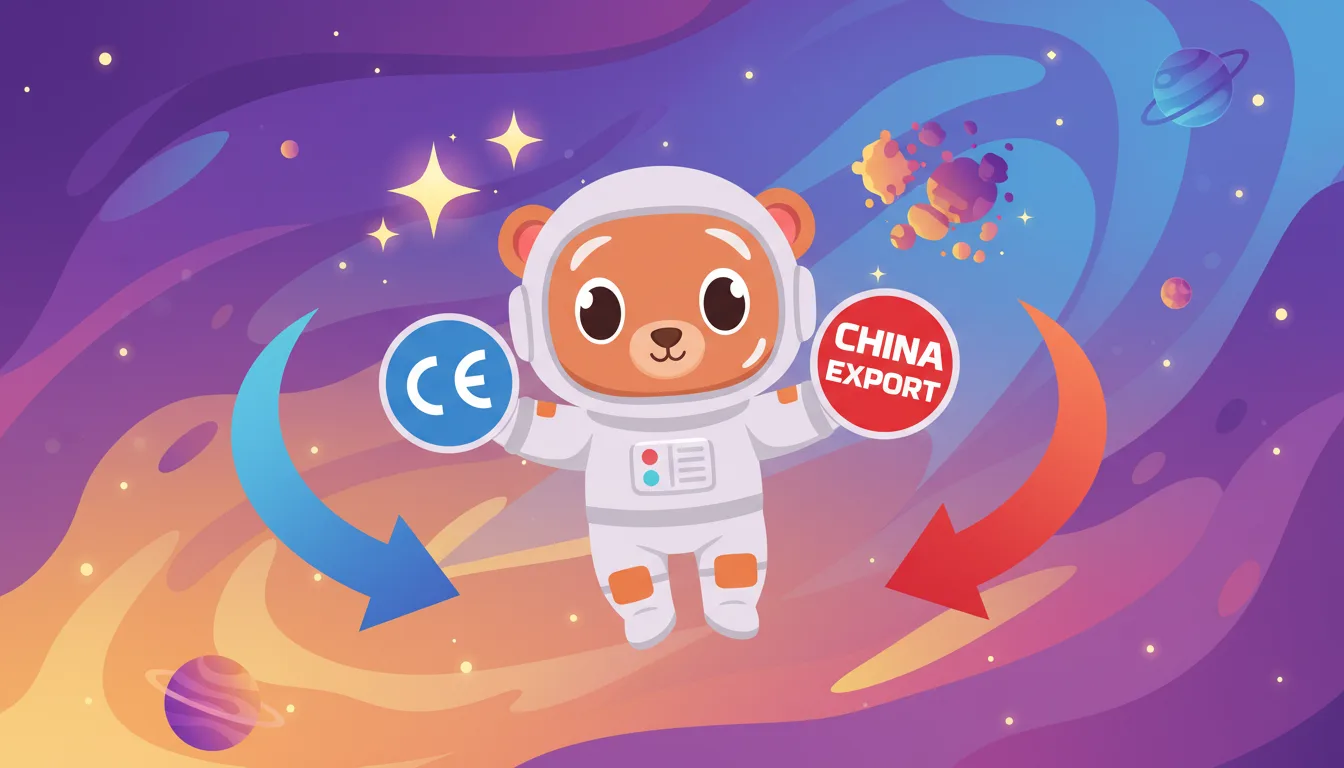

If you import products from China to sell on platforms like bol.com, you need to understand the difference between CE and China Export. The two logos look similar visually, but their meanings are completely different. The CE logo guarantees that a product meets European safety standards, while the China Export label simply indicates that the product was manufactured in China. Using the wrong label on your products can lead to fines, customs seizures, and even legal liability. In this article, we'll explain all the differences, provide concrete identification points, and offer a step-by-step plan so you're always on the right side as an entrepreneur.
What are CE and China Export exactly?
CE marking (Conformité Européenne)
CE stands for Conformité Européenne, or European Conformity. A product with a CE marking has been tested and meets the relevant EU directives on health, safety, and environmental protection. The CE marking is legally required for certain product categories sold within the European Economic Area (EEA) - that includes all EU member states plus Norway, Iceland, and Liechtenstein.
Important EU directives that require CE marking include:
- Low Voltage Directive (2014/35/EU): Electrical appliances between 50 and 1000 V AC
- Toy Safety Directive (2009/48/EC): All toys intended for children up to 14 years old
- Machinery Directive (2006/42/EC): Machines and safety components
- EMC Directive (2014/30/EU): Electromagnetic compatibility of equipment
- REACH Regulation (EC 1907/2006): Chemical substances in products
China Export label
The China Export label is not an official certification mark but a label that some Chinese manufacturers apply to their products to indicate that they were produced in China. There are no quality requirements, tests, or certifications associated with it. The label says nothing about the product's safety or suitability for the European market.
Visual differences between CE and China Export
The biggest danger is the visual similarity. Both labels consist of the letters "C" and "E", but there are specific characteristics that can help you distinguish between them:
| Characteristic | CE marking (Europe) | China Export |
|---|---|---|
| Letter spacing | Clear space between C and E | Letters almost touch |
| Letter design | Standardized according to EU specification | No standardized design |
| Minimum size | At least 5 mm high | No minimum required |
| Meaning | Meets EU directives | Produced in China |
| Legal status | Legally required for certain products | No legal status in the EU |
| Certification | Requires conformity assessment and technical file | No certification required |
| Liability | Manufacturer/importer is legally responsible | No legal protection |
| Enforcement | Market surveillance authorities actively monitor | Not recognized by EU authorities |
A simple test: print the official CE logo on the same scale and place it next to the label on your product. If the letters are too close together or have a different design, you probably have a China Export label in your hands.
Legal risks of incorrect use of CE and China Export
As an importer or seller, you are legally responsible for the products you bring to the European market - regardless of what your supplier claims. The risks of products with a China Export label instead of a genuine CE marking are significant:
- Customs seizure: Customs can stop and seize products without a valid CE marking at the border
- Fines: The Dutch Food and Consumer Product Safety Authority (NVWA) can impose fines of up to €900,000 per violation for trading products that do not comply with EU guidelines
- Product liability: If a consumer suffers damage from an unsafe product, you as the importer are liable. This can lead to damage claims, recalls, and reputational damage
- Removal from sales platforms: Platforms like bol.com and Amazon can remove your products and suspend your sales account if it is found that products do not comply with regulations
- Criminal prosecution: In the case of serious violations, there may be criminal prosecution, especially for products that pose a danger to children
Your responsibility as an online entrepreneur
If you import products from China to sell via bol.com or your own webshop, you as the importer carry the same responsibilities as the original manufacturer. This means you must ensure:
- A conformity assessment of the product according to the applicable EU guidelines
- A technical file with test results, product specifications, and risk analyses
- A EU Declaration of Conformity that you can provide upon request
- The correct CE marking on the product, packaging, and accompanying documentation
- Traceability: Your company name and address must be on the product or packaging
Never blindly trust a "CE certificate" offered by your supplier on Alibaba or another website. Many Chinese manufacturers are not aware of the difference between CE and China Export or deliberately use the wrong label to attract European buyers. Always verify the authenticity of the certification by checking the test results with an accredited testing laboratory.
Step-by-step guide: obtaining the correct CE marking
Follow this step-by-step guide to ensure your products are correctly labeled with a CE marking and comply with all European regulations:
Step 1: Determine the applicable guidelines
Identify which EU guidelines apply to your product category. Use the official EU website for an overview per product group.
Step 2: Have the product tested
Engage an accredited testing laboratory (such as TÜV, SGS, or Bureau Veritas) to test your product according to the applicable standards. Specifically ask for the standards that correspond to the guidelines from step 1.
Step 3: Compile the technical file
Collect all documentation: test results, product specifications, user manuals, risk analyses, and technical drawings. Keep this file for at least 10 years.
Step 4: Draw up the EU Declaration of Conformity
Create a formal statement confirming that the product complies with the relevant EU guidelines. This document must include your company details, product identification, and the applied standards.
Step 5: Affix the CE marking
Display the CE marking visibly, legibly, and indelibly on the product or packaging. Use the standardized design with a minimum height of 5 mm. Don't forget to add your importer details.
Common mistakes when importing from China
Based on common problems in practice, these are the biggest pitfalls for entrepreneurs importing products:
| Mistake | Consequence | Solution |
|---|---|---|
| Relying on supplier "certificates" | Products do not meet EU standards | Have independent testing done at an accredited lab |
| Not distinguishing between CE and China Export | Products are rejected at the border | Check letter spacing and logo design |
| No technical file kept | Fine during NVWA inspection | Compile the file before the first import |
| Applying incorrect guidelines | Incomplete certification | Consult the EU database per product category |
| No importer details on product | Non-compliance with traceability requirements | Add company name and address to packaging |
How Boloo helps you with safe importing and selling
Navigating CE regulations correctly is just one part of successfully selling on bol.com. With the right tools, you can optimize your entire sales process:
- Use the Boloo Product Database to find products with high demand and low competition before investing in CE certification
- Analyze the market with the Product Tracker to see if similar products are already being sold successfully on bol.com
- Calculate your margins including CE certification costs with the Profit Calculator
- Optimize your product pages with the AI Listing Generator so customers trust your products
- Monitor your rankings with the Ranking Checker to see how your products perform compared to competitors
Practical example: importing toys from China
Imagine you're an entrepreneur who wants to import popular toys from China to sell on bol.com. You find a supplier on Alibaba offering "CE-certified" toys at an attractive price. When your shipment arrives, you notice that the logo on the packaging looks slightly different than expected - the letters C and E are noticeably close together.
After researching, it turns out that the toys have the China Export label, not the official CE marking. The toys haven't been tested according to the European Toy Directive (2009/48/EG) and may contain materials that don't comply with the REACH regulation. If you sell these toys and a child gets sick from hazardous substances, you as the importer are fully liable.
The right approach: have the toys tested by an accredited laboratory, compile a technical file, and apply the correct CE marking before offering the product on bol.com.
Frequently asked questions about CE and China Export
Is China Export illegal in the EU?
The China Export label itself is not illegal, but it must not be confused with the CE marking. Products that are subject to CE marking and only have a China Export label may not be sold in the EU.
How do I recognize a fake CE certificate?
Check if the certificate was issued by an accredited testing laboratory (search in the NANDO database of the EU). Ask for the full test report and check if the tested standards match your product category.
Can I apply the CE marking myself?
Yes, for some product categories, the manufacturer or importer can apply the CE marking themselves after carrying out a conformity assessment. For high-risk products (such as medical devices), an independent assessment by a Notified Body is required.
What does CE certification cost on average?
The costs vary greatly per product category: from €500–€1,500 for simple consumer products to €5,000–€20,000+ for complex electronic or medical devices. Always factor these costs into your margin calculation with the Winstcalculator.
Are there any exceptions to CE marking?
Some product categories are exempt from CE marking, such as food, cosmetics, and medicines - these fall under other European regulations. Textiles, furniture, and decorative items without electrical components are generally also exempt, but must still comply with REACH and other chemical safety standards.
Start free with Boloo
Use Boloo's tools to sell smarter on bol.com. Try it for free.
Try Boloo for free